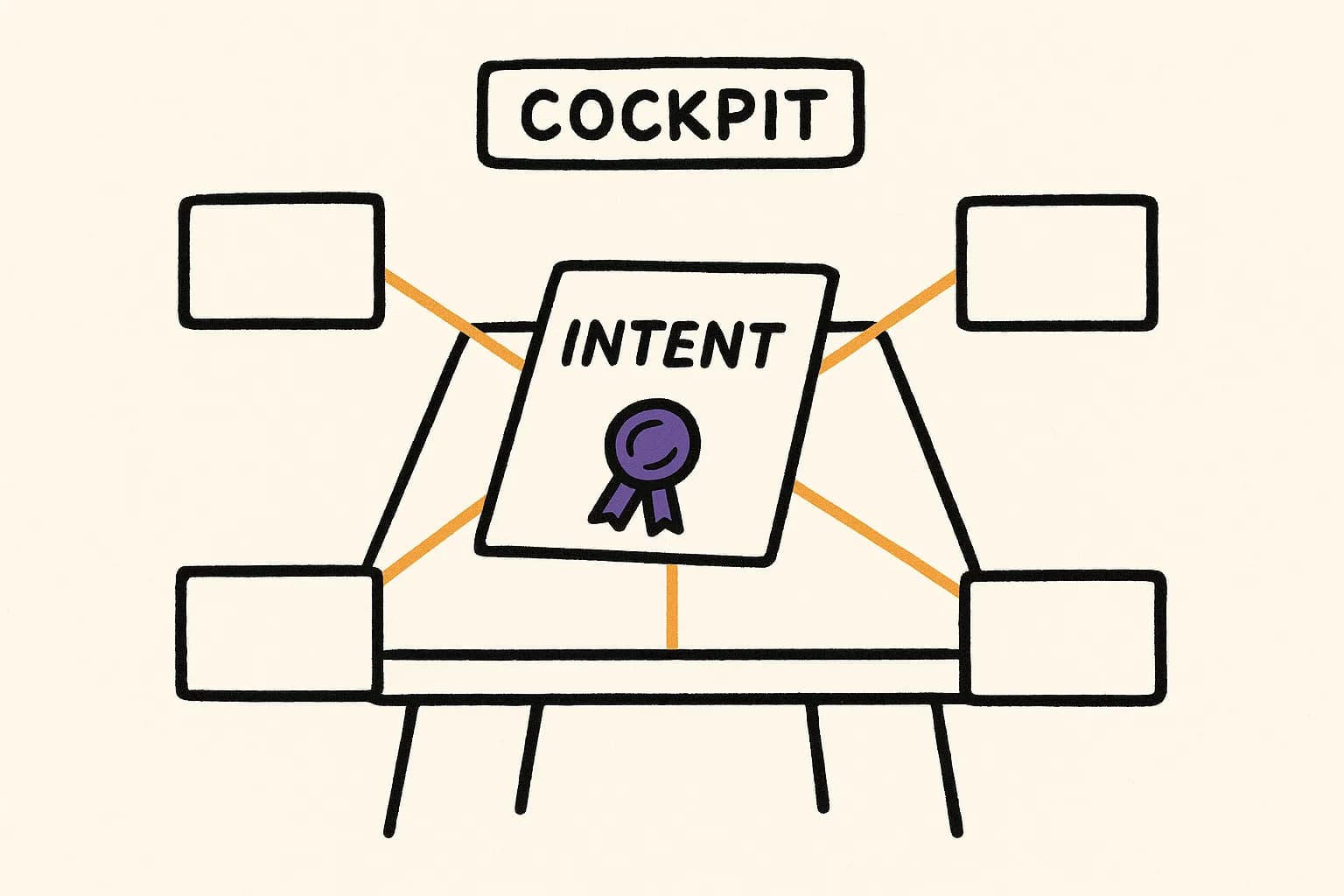
A product leader opens Claude on a Monday morning and asks: "Of the open bugs in Linear, which ones touch behavior our compliance layer explicitly guarantees?" Five minutes later, they have a list of four tickets with reasoning attached. One cites the retention policy that the affected service is supposed to enforce. Two reference a declared constraint on logging PII. The fourth, Claude notes, is touching code that is supposed to be deprecated next quarter per a pace artifact.
That question could not be answered five minutes in a tool that only sees Linear. It requires reading across systems and holding the team's declared intent in mind while doing it. The chat app's ability to connect to multiple MCP servers is what makes the question answerable. Ribo is the connector that turns "looked across the tools" into "looked across the tools against what the team said the system is supposed to be."
The cockpit emerged. The missing piece is intent.
Claude's chat app has quietly become the control surface for operational work in a growing number of orgs. Product managers use it to triage feature requests across Linear and Intercom. Engineering leaders use it to reconcile incident data from Sentry with roadmap commitments. Compliance owners use it to audit support conversations for policy drift. The shift has happened because Claude now supports remote MCP connectors, which means a single chat can pull context from every operational system the team uses.
The pattern that emerges, once teams have five or six connectors plugged in, is that Claude answers questions their dashboards cannot. Dashboards show data. Claude composes across data. The cross-tool queries are where the value compounds.
But the cross-tool queries run into a ceiling that is obvious once you see it. Linear knows what the ticket says. Sentry knows what the exception looks like. Intercom knows what the customer asked. None of them know what the system was supposed to be doing in the first place. That is the missing connector. It is Ribo.
What changes when the cockpit reads intent
Ribo exposes the declared identity of your system over MCP: intent, contract, constraint, compliance, evaluation, tradeoff, glossary, and integration artifacts, all queryable. When Claude has Ribo among its connectors, cross-tool questions gain a second dimension. You are not just asking "what is happening," you are asking "what was supposed to happen."
The Monday-morning bug triage question lands differently. Claude walks the Linear connector to enumerate open bugs. For each, it walks the Ribo connector to find any artifacts the affected component appears in. It cross-references the compliance and constraint artifacts to flag the bugs that intersect with explicit guarantees. It then reads the pace artifact to note deprecation timelines. The output is a ranked list with reasoning: these bugs are not just open, they are open against behavior the team declared. That ranking is a product-leader's tool. It is not a Linear feature.
Similar shapes apply to other cross-tool questions. Which support conversations are asking for features that contradict a declared tradeoff. Which Sentry incidents are happening in code paths that declared an algorithm the incident violates. Which Jira epics are adding scope that sits outside the constraint envelope of the component they touch. Every one of those questions wants Linear, Jira, Sentry, or Intercom plus Ribo. Three without Ribo is data triangulation. Three plus Ribo is triangulation against intent.
Role-appropriate projection for a cockpit
The cockpit reader is not writing code. They are asking questions across a workspace, often on a shared device, sometimes in a public place. The projection should be broad enough to enable the questions they actually ask and narrow enough that a leaked token does not expose the most sensitive parts of your declarations.
Ribo's DNA splits into thirteen layers: intent, contract, algorithm, evaluation, escalation, pace, monitor, glossary, integration, reporting, compliance, constraint, and tradeoff.
For a cockpit user, expose seven: intent, contract, glossary, integration, constraint, tradeoff, and evaluation. Intent tells the cockpit what components are supposed to do. Contract tells it what interfaces they promise. Glossary translates team vocabulary. Integration names the external surfaces the system talks to, which is useful when cross-referencing against Linear, Jira, or Intercom. Constraint and tradeoff name what the system must not become and why. Evaluation tells the cockpit how correctness is measured, which is exactly the dimension a product or compliance leader wants when they ask "is this change touching something we measure?"
Withhold six: algorithm, monitor, reporting, pace, escalation, and compliance. Algorithm is authoring-level detail the cockpit audience does not need. Monitor, reporting, pace, and escalation are runtime and ops concerns. Compliance may feel counterintuitive to withhold, but most teams prefer to route compliance questions to a separate, narrower cockpit session with its own token and audit logs; bundling compliance artifacts into every PM-level chat widens the trust boundary unnecessarily.
Ribo mints a separate bearer token per integration. One cockpit user gets one scoped token. When the same organization has a compliance cockpit, that gets a different token with a different projection.
How to wire it up
First, mint the cockpit token in the Ribo console. Go to Agents, create an agent named after the user and their role (claude-cockpit-<user>-pm or similar). Set scopes to artifact:read. Set projectIds to the Ribo projects the user is authorized to query. Set allowed_kinds to the seven-layer cockpit projection: intent, contract, glossary, integration, constraint, tradeoff, evaluation. Capture the bearer token.
Second, add Ribo to Claude's connector list. In the Claude chat app, open Customize → Connectors, click the "+" to add, and choose Add custom connector (Pro/Max plans). On Team and Enterprise plans, an organization owner adds the connector once under Organization settings → Connectors → Add → Custom → Web, and members enable it individually. The fields:
| Field | Value |
|---|---|
| Connector name | Ribo |
| Remote MCP server URL | https://mcp.ribo.dev/context/mcp |
| Authentication | Bearer token from the Ribo console. If your Ribo workspace is configured for OAuth, open the connector's Advanced settings and supply Client ID / Client Secret instead. |
Save the connector. Open a new chat. Ribo should appear in the tool picker alongside any other connectors you have (Linear, Jira, Sentry, Intercom, Slack, and so on). The questions in the next section assume all four of those are present alongside Ribo; the integration earns its keep the moment more than one connector is active.
What kinds of questions the cockpit can now answer
Three shapes come up repeatedly across teams piloting this:
Compliance-adjacent triage. "Show me support conversations this week that mention data export, and for each, which declared retention or export policy applies." Claude walks the Intercom connector to find the conversations, walks Ribo to pull the constraint or intent artifacts governing export, and returns the pairs.
Roadmap reconciliation. "For each open Jira epic this quarter, tell me if the changes it proposes are consistent with the tradeoffs we declared on the affected components." Claude walks Jira for the epic list, walks Ribo for each component's tradeoff artifacts, and flags mismatches.
Incident-to-intent mapping. "For the Sentry incidents from the last 48 hours, identify which ones are happening in code paths that have a declared evaluation criterion the incident violates." Claude walks Sentry, walks Ribo's evaluation layer, and reports drift.
None of these three questions has a dashboard. They exist because the cockpit can hold both "what happened" and "what was supposed to happen" in the same thought.
What this is for
The cockpit pattern is emerging without a name, and it is emerging because the tools people used to coordinate work (spreadsheets, Slack searches, ad-hoc SQL) were never anchored to what the team said the system was supposed to be. Adding Ribo to the cockpit is not a new category of tool. It is the missing connector in a pattern that already works, which is why the shift is felt as an upgrade rather than as a new workflow.
Claude composes across tools. Ribo gives the composition something to measure against. The cockpit was the form; intent was the missing axis.