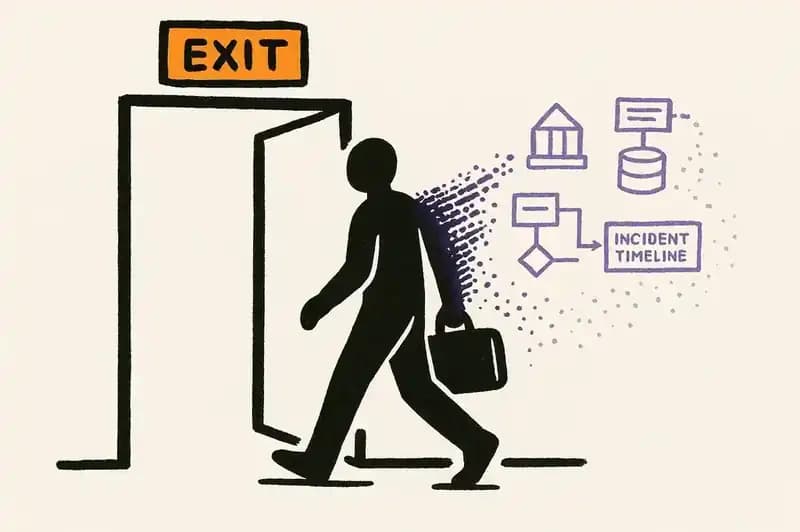
Something is haunting your engineering organization. It has no line item in your budget. No dashboard tracks it. No OKR measures it. But it is, by a wide margin, the most expensive asset you own.
The knowledge inside your people's heads.
Not the code they write. The code is in Git. Not the tickets they close. The tickets are in Jira. Not the architecture diagrams they draw. Those are in Confluence, mostly out of date, but at least they exist.
We mean the other thing. The thing that makes the code make sense. The reason the billing module retries three times before failing, because there was an incident in 2023 that nobody documented, but Sarah remembers. The fact that the payment gateway integration has a 200ms timeout that looks arbitrary but was negotiated with the vendor after six weeks of production failures. The understanding that service-B must always deploy before service-A on Tuesdays because of a data pipeline dependency that is not encoded anywhere -- not in the code, not in the CI config, not in any document -- but lives in Marcus's head, and Marcus's head alone.
Marcus, by the way, is updating his LinkedIn.
The numbers behind the ghost
You can argue about whether institutional knowledge is "the most valuable" asset. The research will argue back.
Avelino et al. studied the bus factor across 1,932 open-source projects and found that 65% had a bus factor of two or fewer. Two people. In two-thirds of all projects studied, if two people disappear, the project's critical knowledge disappears with them. And this was open source -- where the code is public, the commit history is visible, and anyone with an internet connection can theoretically contribute. Inside companies, where code is private and context is held even more closely, the concentration is worse.
Now combine that with how long people actually stay.
Zippia's workforce data shows that 69% of software developers stay at a job for fewer than two years. Not "some developers." Not "junior developers." Sixty-nine percent of all of them. The median tenure in software engineering is not a career. It is a rotation.
When those people leave, they do not just take their salary off your burn rate. They take what they know. Research into organizational knowledge loss has found that 42% of the skills and expertise required to perform in a given role are unique to the individual holding that role. Colleagues cannot replicate 42% of what that person does until the knowledge is rebuilt from scratch. When turnover exceeds 20% annually -- which in engineering it regularly does -- that loss compounds into something that quietly hollows out an organization's ability to operate.
We spend a lot of time talking about technical debt. Knowledge debt is worse. It accrues faster, costs more, and unlike technical debt, you do not realize it exists until someone leaves and takes it with them.
The direct costs are bad. The indirect costs are worse.
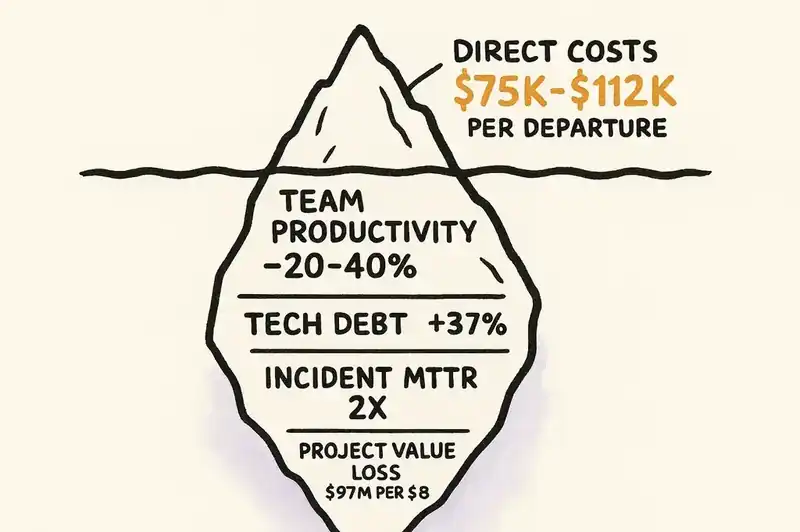
The Society for Human Resource Management estimates that replacing an employee costs six to nine months of their salary. For a senior engineer earning $125K-$175K, that translates to roughly $75,000-$112,000 in direct replacement costs: recruiting, interviewing, onboarding, lost productivity during the ramp-up.
That number is real, and painful. But it is the smaller number.
The larger number is what happens to the team and the codebase after someone leaves. Research on workforce transitions suggests that teams can experience productivity reductions of 20-40% during transition periods. Not a reduction for one person. A reduction for the team. Because the person who left was not just doing their own work. They were answering questions. They were reviewing code with context that the reviewer replacing them does not have. They were the person everyone Slacked when something looked wrong with the event pipeline.
LinearB's engineering productivity data puts the downstream effect in concrete terms: teams with high turnover accumulate 37% more technical debt than stable teams. That is not a coincidence. When the people who understand the system leave, the people who remain make changes with less context. They work around things they do not understand. They add code instead of modifying existing code because modifying existing code requires understanding it. The codebase gets heavier. The debt compounds.
Incident response tells the same story from a different angle. Anyone who has been on-call for an unfamiliar service knows the feeling: staring at a dashboard you have never seen, for a service you did not build, with an architecture you cannot reconstruct from the code alone. Industry data on incident management consistently shows that mean time to resolution increases when responders lack service familiarity -- in many organizations, resolution times nearly double. Every minute of that is revenue lost, reputation damaged, or both.
PMI's research on project performance puts a dollar figure on it: organizations lose an average of $97 million for every $1 billion invested in projects, with poor knowledge management as a consistent driver. Not poor execution. Not poor strategy. Poor transfer of what people know.
The ramp-up tax
New engineers take three to twelve months to reach full productivity, depending on the complexity of the systems they are joining. During that period, they are not only less productive themselves -- they are consuming the productivity of the people around them who are answering their questions, reviewing their code more carefully, and re-explaining context that was never written down.
This is not a failure of the new hire. It is a failure of the organization. We have built engineering teams where the only way to understand what a system does, why it was built the way it was, and what constraints it operates under is to ask someone. And then we act surprised when that person leaves and nobody knows.
Think about what this means at scale. An engineering organization of 100 people with 20% annual turnover replaces 20 engineers per year. Each of those departing engineers takes 42% of their role-specific knowledge with them. Each replacement takes six to twelve months to reach full productivity. At any given time, a meaningful fraction of your engineering team is operating without the context they need to make good decisions.
This is a structural problem. You cannot retain your way out of it, because even in the best case, people leave. You cannot document your way out of it, because documents go stale within weeks and nobody maintains them under deadline pressure. The knowledge is ephemeral because nothing in your system makes it durable.
The M&A magnifying glass
The operational cost of knowledge loss is bad. The capital cost is worse.
When a company gets acquired, the acquiring entity is buying three things: the technology, the customers, and the team. In most software acquisitions, the team -- specifically, the knowledge the team holds -- is the largest component of value.
This creates a paradox. The thing the acquirer is paying for is the thing most likely to walk out the door after the deal closes.
EY's research on post-acquisition retention found that employee turnover averages 47% in the first year after an acquisition. Forty-seven percent. Nearly half the knowledge base that justified the purchase price evaporates within twelve months. Extend the window to three years and the number climbs to 75%.
Acquirers know this. And they price it in.
IRS Revenue Ruling 59-60 explicitly lists the "key person" factor as a consideration in business valuation. The question is not whether key person risk exists. The question is how much it costs. In practice, business valuation professionals apply key person discounts that range from 10% to 25% or more, depending on the degree of concentration. Shannon Pratt, whose work on private company valuation is the standard reference in the field, documented this range extensively. Aswath Damodaran at NYU Stern has written that the proper approach is to value the firm twice -- once with the key people, once without -- and let the delta speak for itself.
For companies where institutional knowledge sits in a small number of engineers, that delta can be enormous. In extreme cases, acquirers apply discounts of 25-40% when key person risk is acute and unmitigated. A company valued at $50 million loses $12.5 to $20 million in value -- not because the technology is worse or the market is smaller, but because the knowledge is trapped in people who might leave.
The broader M&A failure data reinforces the point. A rigorous analysis of 40,000 acquisitions over 40 years found that 70-75% fail to deliver their projected value. McKinsey, KPMG, and Bain have each published similar findings with slightly different methodologies and consistently grim conclusions. The reasons vary -- cultural mismatch, integration failures, strategic miscalculation -- but knowledge loss is a through-line in nearly all of them. When the people who understand the acquired technology leave, the technology becomes a black box that the acquiring team cannot operate, maintain, or extend at the pace the deal model assumed.
Seventy percent of deals failing to deliver projected value. Forty-seven percent employee turnover in year one. Forty-two percent of role-specific knowledge unique to the individual. These numbers are not independent. They are causally linked.
The ghost is a choice
What makes this problem unusual is that it is entirely self-inflicted.
We build software systems that are complex, interdependent, and constantly changing. We staff those systems with people who, statistically, will leave within two years. And then we store the critical knowledge about those systems in the one place guaranteed to be impermanent: the people themselves.
We have version control for code. Infrastructure-as-code for environments. Contract testing for APIs. Monitoring for runtime behavior. But no persistent, machine-readable, version-controlled layer that captures what a system is, why it exists, what constraints it honors, and how it relates to everything around it.
The ghost in your engineering org is not the knowledge itself. Engineers generate that every day -- through design decisions, incident responses, architectural trade-offs, production debugging sessions. The ghost is the absence of a place to put it that survives the person who generated it.
What externalized knowledge looks like
The alternative is not "better documentation." We have tried documentation. It does not work at scale because it requires ongoing human effort with no enforcement mechanism and no feedback loop. Documents drift from reality within days, and the drift is invisible until someone relies on the document and gets burned.
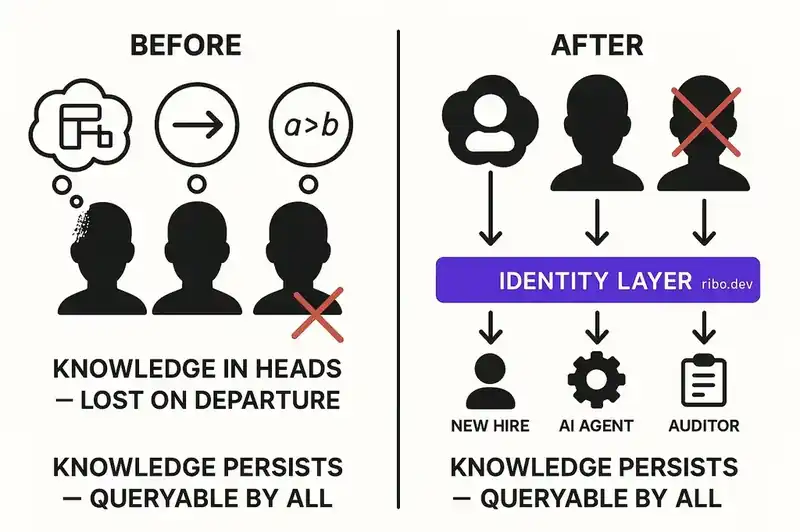
The alternative is a persistent identity layer for software -- a structured, machine-readable declaration of what each system is, what it does, what contracts it honors, what constraints it operates under, and how it connects to everything else. Not a description of the code. A declaration of the intent behind it, maintained as a first-class artifact that is version-controlled, continuously validated, and queryable by both humans and machines.
That is what it means to externalize institutional knowledge. You take the things that currently live only in Sarah's head and Marcus's head and the head of the on-call engineer who quit last month, and you encode them in a layer that persists independently of any individual. The knowledge survives turnover. It survives acquisitions. It survives the 3am incident where nobody awake has ever touched the service that is down.
When the knowledge is externalized, new engineers do not need six months to reach productivity. They can query the identity of the system they are working on and understand its purpose, its boundaries, its constraints, and its relationships before they read a single line of code. When an incident fires, the on-call engineer does not need to reconstruct the architecture from commit history and Slack searches. The architecture is declared, current, and machine-readable.
When a potential acquirer does due diligence, they do not find a company whose value is concentrated in the heads of three senior engineers who may or may not stay after the deal closes. They find a company whose institutional knowledge is externalized, persistent, and transferable. The key person discount shrinks. The valuation holds.
The CFO question
If you are an engineering leader, you can frame this as a technical problem and solve it with better tooling and process. That works, to a point.
But the honest framing is financial. Every quarter, your engineering organization generates institutional knowledge that is not captured anywhere persistent. That knowledge has real economic value -- it is the difference between a team that can ship and a team that is fumbling in the dark. And every quarter, some percentage of that knowledge walks out the door permanently.
The question is not whether you can afford to externalize your institutional knowledge. The question is whether you can afford not to.
Here is a back-of-the-envelope calculation for a 100-person engineering org with median salaries:
- 20% annual turnover: 20 departures per year
- Direct replacement cost per departure: $75K-$112K
- Total direct replacement cost: $1.5M-$2.2M per year
- Productivity loss during transitions (20-40% reduction, 6-month average): millions more in delayed delivery
- Incremental technical debt from context loss (37% more debt in high-turnover teams): compounding cost, year over year
- Incident response premium for unfamiliar services: measured in downtime, SLA breaches, and customer trust
Add it up. You are looking at a multi-million dollar annual cost that does not appear on any dashboard, in any budget review, or on any executive's radar. The ghost. The most expensive thing in your engineering organization. Entirely invisible until you decide to look at it.
Most organizations, when they finally look, do not like what they find.
The ones that do something about it stop losing their most valuable asset every time someone updates their LinkedIn.